
Two people can use the same shampoo, conditioner and styling products yet experience completely different results. One may find that their hair feels soft and manageable, while the other notices that it becomes heavy, dry or difficult to style. The difference is not necessarily the quality of the products. It may have more to do with the individual characteristics of their hair.
One of these characteristics is porosity: the hair’s ability to absorb and retain moisture. Although it is not always discussed as openly as texture or density, porosity can influence how hair responds to cleansing, conditioning, colouring and everyday styling.
Understanding it offers a more informed way to approach haircare. Instead of choosing products simply because they are popular or recommended for a particular hair type, it becomes possible to consider what the hair actually needs.
What Does Hair Porosity Mean?
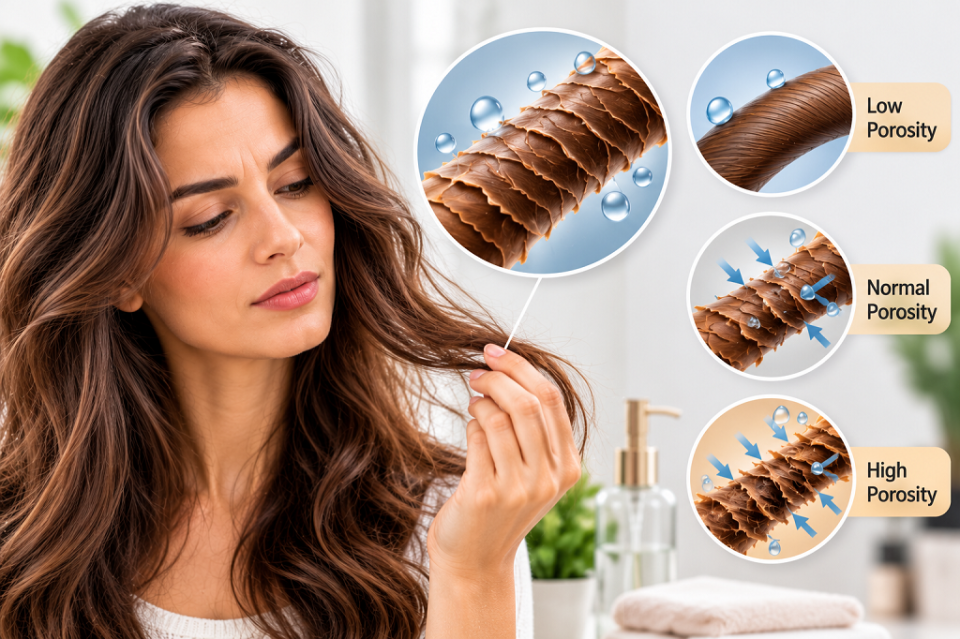
The outer surface of each hair strand is made up of overlapping protective cells known as the cuticle. Their arrangement influences how easily moisture and certain ingredients can enter and leave the hair.
Hair porosity is commonly described in three broad categories: low, medium and high. These categories are useful for understanding general behaviour, although real hair does not always fit neatly into one group. Porosity can vary along the length of a strand and may also be influenced by chemical treatments, heat styling and environmental exposure.
Low-porosity hair tends to have a more compact cuticle structure. It may take longer to become fully wet and can sometimes feel as though products sit on the surface rather than distributing easily.
Medium-porosity hair often absorbs and retains moisture relatively comfortably. It may be easier to manage and respond well to a balanced routine.
High-porosity hair has a more open or disrupted cuticle structure, which can allow moisture to enter quickly but also escape more easily. It may feel dry, become tangled or require more attention to conditioning.
These descriptions are not diagnoses or fixed labels. They are simply a starting point for observing how individual hair behaves.
Why One Product Does Not Work for Everyone
Haircare products are formulated with different purposes in mind. Some focus on cleansing, others on conditioning, smoothing, strengthening or styling. Their effectiveness depends partly on how well their formulation suits the hair.
For example, a rich conditioner may be useful for hair that feels dry and difficult to manage. However, the same formula might leave finer hair feeling weighed down. A lightweight product may provide a more comfortable finish for someone who wants movement and volume, but it may not offer enough conditioning for thicker or more porous lengths.
This is why product selection should involve more than choosing something labelled for dry, fine or damaged hair. Those descriptions can be helpful, but they do not always explain how the hair will respond.
Observing the results is important. Does the hair feel soft after conditioning, or does it become limp? Does styling product improve definition, or does it leave a coating? Does the hair remain manageable until the next wash?
These everyday observations can reveal more about an effective routine than following a long list of general recommendations.
The Influence of Colour and Heat
Hair porosity is not always something determined by natural characteristics alone. Chemical processing and repeated heat exposure can affect the cuticle, changing how the hair absorbs and retains moisture.
Colour treatments, particularly those involving lightening, can alter the structure of the hair. As a result, previously coloured lengths may behave differently from newly grown roots. Someone with naturally low-porosity hair may therefore experience greater porosity through sections that have been chemically treated.
Heat styling can also contribute to changes in the hair’s condition, particularly when high temperatures are used frequently or without appropriate protection. Over time, this may affect smoothness, elasticity and the way products perform.
Understanding these differences can help explain why a routine that once worked well may no longer produce the same result. It may be necessary to adjust conditioning, styling methods or the amount of product used as the hair changes.
For professional advice on selecting suitable treatments and styling services, experienced hairdressers at a Central London salon can help assess the hair’s condition and discuss an approach that reflects its individual needs.
Building a More Considered Routine
A useful haircare routine does not need to be complicated. In fact, understanding porosity can help simplify product choices by focusing attention on how the hair responds.
For hair that seems resistant to moisture, using a suitable conditioner and allowing it to distribute evenly may help improve manageability. Lightweight formulas may be preferable if heavier products leave a coating or reduce natural movement.
Hair that loses moisture easily may benefit from consistent conditioning and careful handling. Products designed to support softness can help improve the feel of the lengths, while gentle detangling reduces unnecessary pulling and friction.
The amount of product matters, too. Applying more does not automatically produce better results. A small quantity distributed evenly may be more effective than a generous application concentrated in one area.
It is also worth reviewing the routine occasionally. Changes in hair length, colour, season and styling habits can influence what feels comfortable. A flexible approach is usually more useful than following the same combination of products indefinitely.
Avoiding Common Porosity Myths
Online haircare discussions often present simple tests that claim to identify porosity, including placing a strand of hair in a glass of water and observing whether it floats or sinks. While such demonstrations can be interesting, they are not reliable ways to establish a complete picture of hair porosity. Surface residue, strand condition and other variables can affect the result.
It is more useful to observe how the hair behaves during washing, conditioning and styling. Does it become wet easily? Does it dry quickly? Does it feel rough despite conditioning? Does it become weighed down by certain products?
Even these observations should be considered alongside other characteristics, including texture, density and overall condition. Porosity is one part of a much larger picture.
Better Haircare Begins With Understanding
The purpose of understanding hair porosity is not to create another complicated category or make everyday haircare feel like a science experiment. It is to recognise that different hair responds differently, and that effective care depends on those individual differences.
Once the hair’s behaviour becomes clearer, choosing suitable products and styling methods can become a more straightforward process. There is less need to follow every new recommendation and more opportunity to develop a routine based on experience.
Whether someone has naturally fine hair, thick curls, coloured lengths or a combination of textures, paying attention to how the hair absorbs and retains moisture can provide useful insight.
Ultimately, good haircare is not about owning the largest collection of products. It is about understanding what each product is intended to do, recognising what the hair responds to and making thoughtful choices that support its condition over time.
